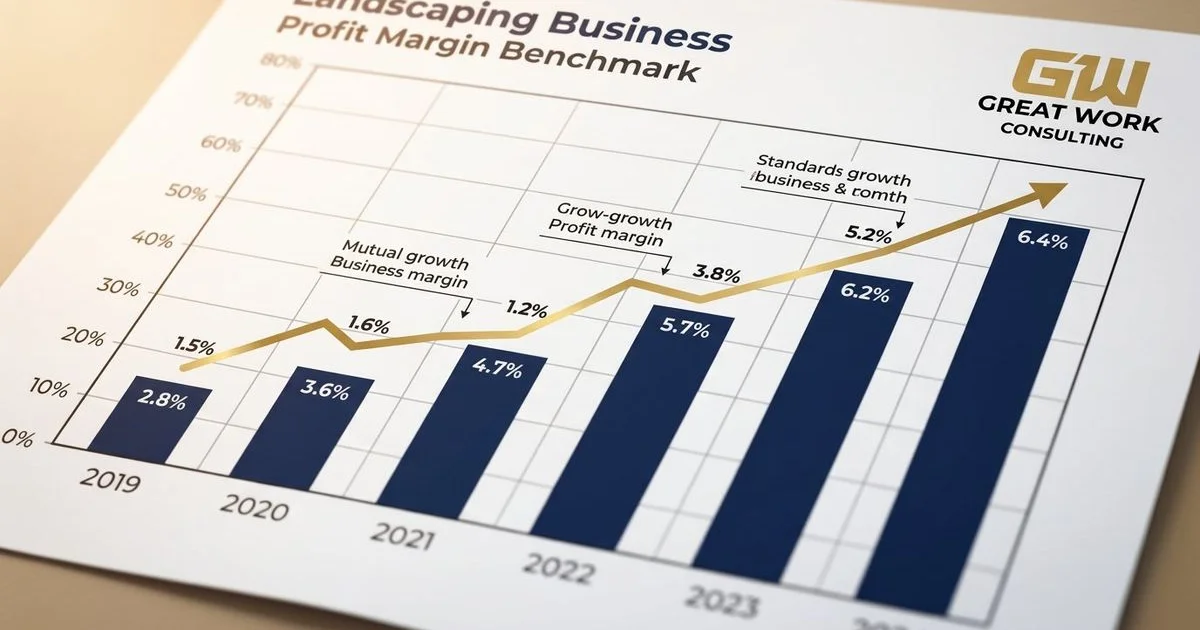
We frequently hear ten different answers when asking ten US landscaping business owners about their profitability. Some owners quote their gross margin while mistakenly thinking it is their net. Others confuse standard markup with margin.
Our experience shows that most contractors treat these numbers as a mystery rather than an active metric. Profit margin is the absolute most important number in your business. It dictates whether you can buy new equipment, weather a slow winter, or build a company worth selling.
We know that understanding exactly what profit margins should landscaping businesses actually target is the first real step toward financial health.
The US landscape market is expected to reach $200 billion by the end of 2026. You need precise data to capture your fair share of that growth.
Gross Margin vs. Net Margin: What Profit Margins Should Landscaping Businesses Actually Target?
Our financial team always starts by clarifying the two types of margin that dictate your success. Gross margin represents your total revenue minus direct project costs, which includes materials, field labor, equipment fuel, and subcontractors. This metric reveals exactly how much money you keep from a specific project before paying for your company overhead.
We utilize financial models showing that a healthy US landscaping company should target a 30 to 50 percent gross margin. Net margin is your true profit after subtracting all indirect costs. Indirect expenses include rent, general liability insurance, office staff, marketing, and the often-forgotten equipment depreciation.
Our audits frequently reveal that equipment depreciation alone can eat up 5 to 10 percent of total revenue. A landscaping business might boast a 50 percent gross margin but only take home a 10 percent net margin once the back-office costs are paid. Both numbers are critical, but net margin determines if you are building actual wealth.
“A 50 percent gross margin looks great on paper, but a 10 percent net margin is what pays your mortgage.”
Industry Benchmarks by Service Type
We track performance across the US outdoor living sector to establish realistic benchmarks. Profitability changes drastically depending on the specific type of work you perform. Service mix matters far more than total volume when trying to build a sustainable bottom line.
Maintenance and Mowing
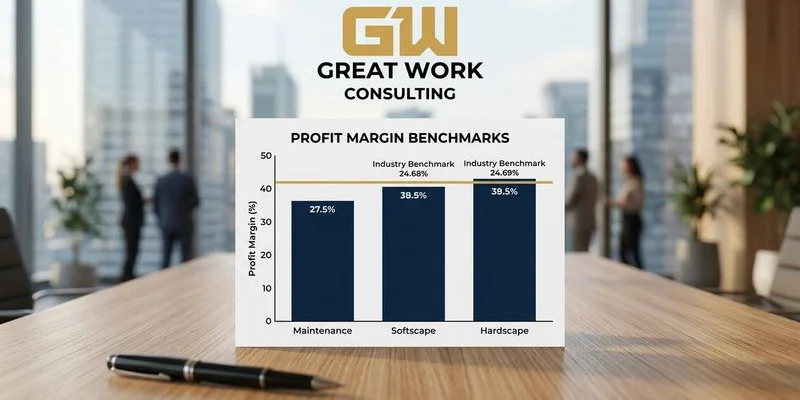
Our data for 2026 shows that routine maintenance operates on very specific margins.
- Gross margin target: 50 to 60 percent
- Net margin target: 10 to 15 percent
Maintenance work involves lower material costs but demands extreme labor intensity. Route density is the absolute key to making money here.
We recognize that a 2026 forecast from the National Association of Landscape Professionals projects labor wages will rise up to 20 percent by 2029. This makes efficient crew deployment completely mandatory. Companies must adapt to survive these wage hikes.
Our consulting group advises clients to use routing software like RealGreen Service Assistant 5 to minimize windshield time. Companies running tight routes can push their net margins to the 15 percent ceiling. Crews with scattered properties often struggle to break a 5 percent net margin.
Landscape Installation (Softscape)
We establish target benchmarks for softscape work that focus heavily on accurate estimating.
- Gross margin target: 45 to 55 percent
- Net margin target: 10 to 18 percent
Planting, grading, and irrigation carry moderate material costs alongside significant labor requirements. Underestimating labor hours is the leading margin killer in this specific category.
Our preferred digital takeoff tools, like Ottermap, are helping contractors reduce material waste by up to 25 percent. These satellite systems eliminate the guesswork of manual site measurements. You cannot afford to guess how many cubic yards of mulch a property needs.
Hardscaping and Outdoor Living
We view hardscaping as the ideal path to premium profitability.
- Gross margin target: 45 to 55 percent
- Net margin target: 15 to 25 percent
Patios, retaining walls, and outdoor kitchens require specialized skills that command much higher project values. Hardscape projects also involve heavy materials that carry a mandatory 10 to 15 percent waste factor for cutting and compaction.
Our experience shows that contractors who fail to account for this waste end up paying for the extra pallets out of their own pocket. The preferred strategy for this category is combining value-based pricing with accurate job costing. Tight operational execution is what turns a beautiful patio into a profitable one.
Design-Build Projects
We consider comprehensive design-build projects to be the ultimate revenue generator.
- Gross margin target: 50 to 60 percent
- Net margin target: 20 to 30 percent
Managing the entire site reduces the fragmentation that normally erodes profits. The landscape architecture component adds perceived value that easily justifies premium pricing.
Our financial audits reveal that homeowners are willing to pay more for a single point of contact instead of hiring multiple independent contractors. You should structure these contracts so the design fees cover your initial consultation and planning time. Charging for the design protects your baseline profitability before ground is even broken.
Why Your Margins Might Be Lower Than They Should Be
We frequently uncover the same common causes for low profitability across the US market. If your net margins are consistently falling below the 10 percent benchmark, you have a systemic leak. Identifying these leaks requires an honest look at your daily operations.
Underpricing Your Work
Our experts see that the most common margin killer is simply pricing work too low. Many contractors set their rates based on what they assume the local market will accept. This creates a race to the bottom that is especially common in competitive bidding situations.
We recommend fixing this by knowing your precise costs and applying a clear formula.
- Track direct material costs.
- Calculate total labor hours.
- Add a non-negotiable profit percentage.
If a project costs $28,000 to deliver and you want a 20 percent net margin, the final price must be $35,000. Dropping your price to win a bid usually guarantees you will work for free.
Our top advice is to always find customers who value quality over the lowest possible estimate. You can learn more about strategic positioning in our guide on pricing outdoor living projects. A confident presentation often closes the sale at the higher rate.
Poor Labor Productivity
We know from industry data that labor is your largest controllable expense. If your crews take 20 percent longer than estimated, your profits are eroding by thousands of dollars per month. A major culprit is unbilled drive time and morning staging at the shop.
Our assessments show that many contractors fail to account for the hidden logistics of a work day.
- Morning material loading.
- Fueling trucks at the station.
- Unloading debris at the yard.
A crew might leave the job site at noon, but they are still on the clock for these tasks. This means a half-day estimate actually costs you a full day of overhead.
We advise building your estimates using full-day blocks to ensure overhead is fully covered. Unclear daily work plans and excessive downtime between tasks also destroy efficiency. Workers should never spend paid time searching for tools instead of installing them.
Overhead Creep
Our team constantly warns business owners that overhead grows silently. A new truck payment here and a new software subscription there will quietly eat your cash flow. A 2025 Aspire software survey found that 29 percent of commercial landscapers use 10 or more different software solutions to run their business.
We refer to this tech stack bloat as a prime example of overhead creep. General liability insurance premiums are also rising quickly. Before you realize it, your monthly fixed costs jump by $3,000 without any change in project pricing.
Our policy is to review indirect expenses on a strict quarterly basis. Every single subscription or lease must justify its existence.
“If an expense does not directly support revenue generation or reduce field costs, cut it immediately.”
Not Tracking Job Costs
We firmly believe that you cannot manage what you do not measure. You have no way to know which projects are bleeding money if you ignore actual costs. Most contractors fail to track allocated equipment fuel and exact labor hours per site.
Our teams rely on modern platforms like Jobber or LMN to capture this field data in real time. A good system reveals the true profitability of every single task. The difference between guesswork and accurate data is staggering.
We offer dedicated financial consulting services to help contractors build practical tracking systems. These systems actually work in the field without overwhelming your foremen. Below is a clear comparison of what effective tracking looks like.
| Bad Job Costing | Good Job Costing |
|---|---|
| Guessing fuel costs | Tracking exact mileage per route |
| Estimating in half-days | Billing in full-day blocks |
| Ignoring material waste | Adding a 10% contingency |
Strategies to Improve Your Margins
Our experience proves that improving profitability does not always require doubling your sales volume. Small, deliberate changes to your operations yield massive returns. You can implement several targeted strategies right now to protect your bottom line.
Raise Prices Strategically
We highly recommend rolling out a 5 to 10 percent price increase to combat inflation. If your work quality is strong, your existing customer base will usually accept this adjustment. The best approach is sending a formal price increase letter 30 to 60 days in advance.
Our clients find success by offering value-based packages when adjusting their rates.
“Instead of just raising a mowing fee, you can offer a comprehensive seasonal care package.”
A bundled service increases the total transaction value while softening the impact of the higher rate.
We suggest starting your new pricing model with fresh leads who have no previous price anchors. This immediately boosts your net margins with zero additional work volume. Confident pricing attracts clients who value reliability over finding the cheapest option.
Improve Estimating Accuracy
Our audits consistently reveal that inaccurate estimates are the fastest way to destroy profit. Giving away margin on every project is inevitable if you underestimate material quantities. You must review completed jobs to identify exactly where your initial bids deviated from actual expenses.
We advise contractors to use dedicated estimation software like Clear Estimates to standardize their process.
- Store current material costs.
- Automate your labor formulas.
- Eliminate mathematical errors.
Our standard practice is to include a 5 to 10 percent contingency fund on every residential bid. This buffer absorbs unforeseen issues like discovering buried rock during an excavation. Adjust your future estimating formulas immediately when you notice a recurring miscalculation.
Reduce Material Waste
We constantly see material waste eating up between 10 and 15 percent of a hardscape budget. Broken pavers and compacted base gravel are unavoidable realities of outdoor construction. Tighter material takeoffs and better site storage practices can reduce this loss significantly.
Our favorite tip is to train crews on highly efficient cutting techniques. Getting your waste down to 5 percent on a $15,000 material budget recovers $1,500 in pure profit. You should also build strong relationships with suppliers to handle damaged deliveries quickly.
Invest in Crew Training
We know that a well-trained crew works faster and makes far fewer expensive mistakes. The return on investment for formal field training is absolutely enormous. A crew that boosts productivity by 10 percent effectively lowers your labor cost by 10 percent on every job.

Our most profitable clients treat their workforce as an asset rather than an expense. Teaching an employee how to operate a skid steer efficiently saves hours of wasted rental time. Fast, high-quality results translate directly into higher net margins and better customer reviews.
Focus on Higher-Margin Work
We remind every business owner that not all landscaping revenue is created equal. If your maintenance division runs at a 10 percent margin while hardscaping hits 22 percent, your growth strategy should reflect that. Selling more patios will improve your total financial health much faster than adding fifty new mowing accounts.
Our perspective is not that you should completely abandon your recurring maintenance routes. Recurring revenue provides essential cash flow during slower installation months. You simply need to understand the financial profile of each service line and allocate your marketing budget accordingly.
Set Margin Targets and Track Them Monthly
We believe that knowing industry benchmarks is completely useless if you never compare your own performance against them. You must set a specific target for every single service line you offer. Tracking these actual numbers monthly keeps you from flying blind.
Our strict rule is to investigate immediately when profitability dips below your established goal.
“Waiting until tax season to discover a massive cash leak is a recipe for bankruptcy.”
The most successful contractors treat these percentages as an active management tool.
We tell our partners to run monthly profit and loss statements broken down by division. This granular reporting highlights exactly which crews are thriving and which ones need help. Regular financial reviews prevent small inefficiencies from becoming catastrophic losses.
Know Your Numbers, Grow Your Business
Our team wants you to realize that tracking profitability is not just a boring accounting exercise. These numbers form the financial foundation that determines if your company can actually survive. Strong profits allow you to attract great employees, buy modern equipment, and achieve the lifestyle you wanted.
We know that thin margins will only bring you stress and burnout.
Taking control of your data gives you the freedom to confidently scale your operations. Learning exactly what profit margins should landscaping businesses actually target is your crucial first step.
Our financial experts are ready to help you analyze your current performance. Want to know where your margins really stand and how to improve them? Book a Free Operations Audit and our financial team will analyze your current profitability and build a roadmap to healthier margins across every service line.