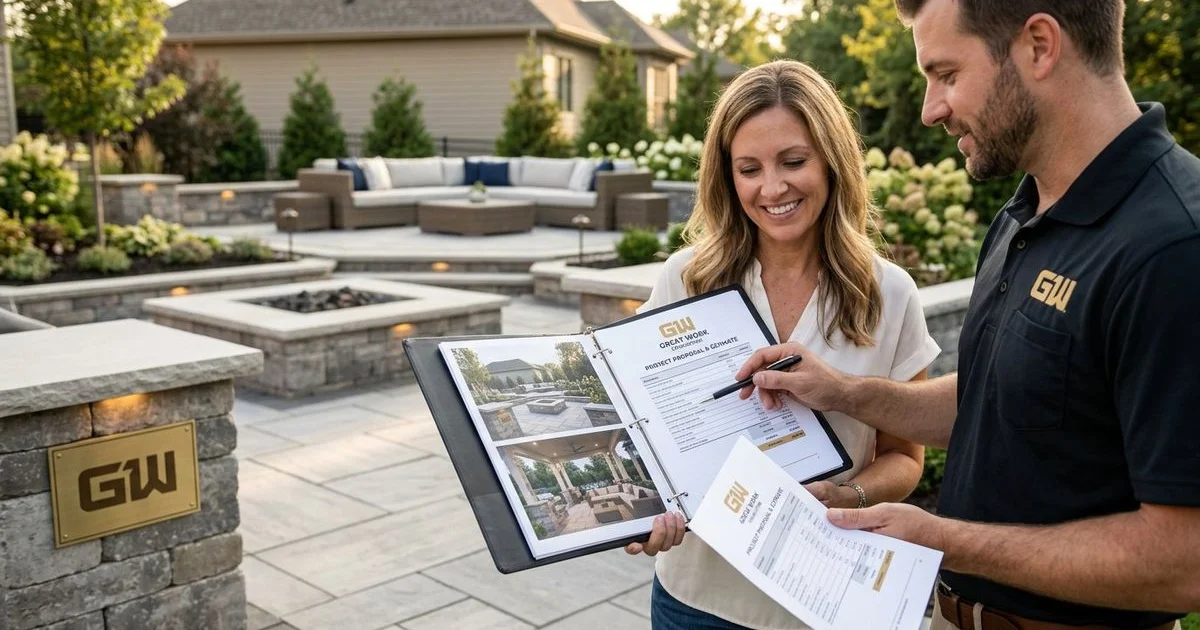
We see it all the time in the outdoor living space: contractors working seventy-hour weeks while their bank accounts barely budge. This happens because pricing is the single highest-leverage decision a business owner makes. Guessing at your numbers will starve your company of the profit it desperately needs to grow.
Our team knows that strategic pricing requires understanding your true costs and positioning those numbers to support a sustainable business. You cannot just charge the absolute maximum and hope for the best.
Gut feelings have no place in a professional estimating process.
We are going to look at the actual data behind profitable estimates and explore how to price outdoor living projects without leaving money on the table.
The Three Pricing Approaches
Three fundamental pricing strategies dominate the hardscaping and landscape construction market. Each approach carries specific strengths and weaknesses depending on the project type and your target customer segment. Our most successful clients use a blend of these models to maximize their returns.
Cost-Plus Pricing
Cost-plus pricing represents the most straightforward mathematical approach to estimating. You simply calculate the total cost to deliver the project and add a predetermined profit percentage on top. We recommend capturing every single expense, including materials, labor, equipment, subcontractors, and overhead. Modern job costing tools like Elevation Advisor pull material costs directly from your catalogs to prevent numbers from drifting between bids. The process follows a clear and logical order.
- We always start by calculating total material costs from a precise takeoff.
- Next, estimate labor hours and multiply them by your fully loaded labor rate.
- Add equipment costs, including rental fees or allocated ownership expenses.
- Our process then factors in any specialized subcontractor costs.
- Allocate your indirect overhead based on the expected project duration.
- Finally, tack on a target profit margin, which typically sits between 15 and 25 percent of the total cost.
Our favorite example involves a paver patio project with $27,000 in total costs, including $3,200 specifically allocated for overhead. Applying a 20 percent profit margin brings the final project price to $33,750. Cost-plus pricing ensures you cover expenses and earn a predictable margin on every single job.
We do see a major downside to this method: it caps your earning potential. Earning the same flat percentage on a price-sensitive homeowner feels very different than building a $200,000 outdoor entertainment complex for a high-net-worth client. For detailed guidance on tracking these expenses accurately, review this job costing guide for hardscape projects.
Value-Based Pricing
Our preferred model for high-end projects is value-based pricing, which sets figures based on the perceived benefit to the customer. This approach recognizes that a beautifully designed outdoor kitchen does much more than consume block and mortar. A luxury installation creates a premium living space, boosts property value, and delivers decades of entertainment.
We find that a well-designed patio can boost a property’s value by 8 to 10 percent, delivering an incredible return on investment for the homeowner. Value-based pricing shines in a few specific scenarios.
- It works best when you offer comprehensive design-build services rather than basic installation.
- Our highest-earning contractors successfully target projects that carry massive emotional value, like a custom poolscape.
- Clients happily pay a premium when your work quality sits demonstrably higher than the local competition.
- You must be able to articulate that value through portfolios and polished presentations.
We acknowledge that the main challenge with this strategy is that it requires serious confidence and refined sales skills. You must justify why your $55,000 patio is worth $15,000 more than a competitor’s quote. Coach yourself to build that justification through a professional design process, superior material selections, and an unmatched customer experience.
Competitive Pricing
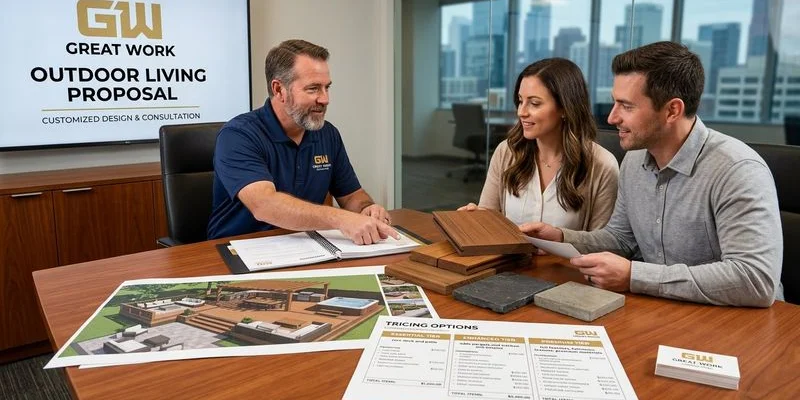
Our financial analysts define competitive pricing as setting your rates relative to what other contractors in your specific market currently charge. This involves researching the competition through mystery shopping, industry data, and customer feedback on competing bids. Setting prices based solely on what the guy down the street charges lets his broken cost structure dictate your future.
We warn contractors that the average landscaping business profit margin hovers around a dangerous 5.5 percent, according to 2025 IBISWorld data. Matching a bid from a competitor operating at a 5.5 percent margin puts your own business on the brink of failure. Use competitive intelligence to validate your positioning, not to set your baseline. We recommend knowing what the market bears, but always base the final number on your own costs and the unique value you deliver.
Why Most Contractors Underprice Their Work
Underpricing remains the most dangerous epidemic in the outdoor living industry. Several psychological and structural hurdles cause highly skilled builders to give their profits away. We know the industry requires a massive shift in mindset to correct this ongoing issue.
Fear of Losing the Bid
Fear of rejection drives the vast majority of underpriced estimates. Contractors worry that a higher price will send the client running, so they shave off margin to appear more attractive. We consider this fear-based tactic to be completely self-defeating.
It attracts highly price-sensitive customers while creating thin margins that leave absolutely zero room for unexpected site issues. The U.S. landscaping services market is worth over $130 billion, meaning there is plenty of high-quality work available for true professionals. We see that homeowners investing $40,000 in a new space are looking for a contractor they trust, not the cheapest guy in the county. Profitable companies build that deep trust through a consultative sales process rather than a race to the bottom.
Failure to Account for All Costs
Countless business owners drastically underestimate their true operational expenses. We constantly see operators omit indirect overhead, use base employee wages instead of fully loaded labor rates, or completely ignore material waste. Indirect overhead typically consumes at least 20 percent of a landscape professional’s total sales.
Missing that massive 20 percent chunk means your actual profit margin gets wiped out before the crew even breaks ground.
We point clients toward accurate job costing as an absolute prerequisite for survival. Setting profitable prices is impossible if you do not know your exact break-even point.
Comparing Yourself to Low-End Competitors
Every local market features a handful of operators who charge rock-bottom prices. We strongly advise against comparing your rates to new, uninsured, or desperate companies cutting structural corners. Many of them do not understand their numbers and are slowly going bankrupt while looking incredibly busy. Recent data from Service Autopilot shows that established, highly efficient design-build firms achieve net profit margins between 25 and 40 percent.
We highly recommend comparing your operation strictly to those top-tier businesses. That is the only competitive set that truly matters for long-term success.
How to Price Outdoor Living Projects Without Leaving Money on the Table
Implementing a few structural changes to your sales presentation can drastically improve your bottom line. Our consulting team has identified three specific tactics that insulate your profits from aggressive negotiation.
Tiered Proposals
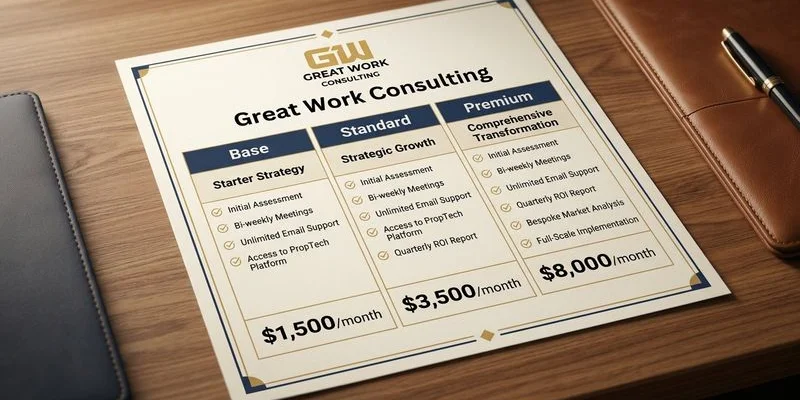
Instead of presenting a single take-it-or-leave-it price, offer three distinct options. A structured presentation usually includes a base package, a standard package, and a premium luxury package. We design the base package to cover the core project scope without any frills.
The standard package introduces design enhancements, upgraded materials, or secondary features like low-voltage lighting. The premium tier includes every single feature the homeowner mentioned during the initial consultation. We use tiered proposals to effectively anchor the customer’s financial perception.
Placing a $75,000 premium package next to a $45,000 standard option instantly makes the middle tier feel reasonable and safe. Giving the client control over the final budget reduces direct price objections and dramatically increases the closing rate. We almost always see clients choose that middle option, so you should design it as your target profit goal.
Price by Project, Not by Square Foot
Square foot pricing commoditizes your craftsmanship and invites direct comparison with every cheap contractor in town. A prospect holding three quotes priced per square foot will instinctively choose the lowest number. We advise pricing by the complete project scope based on design complexity, specific site conditions, and material selections.
| Patio Type | Estimated Cost Per Square Foot (2026) | Key Cost Drivers |
|---|---|---|
| Basic Ground-Level Patio | $5 to $35 | According to 2026 data from Angi, installing a basic ground-level patio costs between $5 and $35 per square foot. |
| Elevated Custom Patio | $10 to $85 | An elevated patio requires complex grading and structural support, pushing that cost up to $85 per square foot. |
Our data shows that presenting a blended per-square-foot number for a complex layout makes you look identical to a guy pouring a flat concrete slab. Package the entire value together to prevent clients from line-item shopping.
Charge Separately for Design
Professional design services require immense skill and carry massive tangible value. We strongly recommend charging a dedicated fee if you provide detailed 3D renderings and phasing plans. Giving this intellectual property away for free devalues your expertise. It also attracts serial shoppers who just want free concepts to hand to a cheaper installer.
We suggest implementing a design fee ranging from $500 to $2,500 depending on the project’s scale. You can easily credit this fee toward the final installation contract if the customer proceeds with the build. This simple filter eliminates uncommitted prospects and ensures compensation for hours spent in rendering software like SketchUp or Vip3D.
Handling Price Objections
We teach contractors to resist the urge to immediately drop their price when a homeowner says the quote is too high. Instead of instantly caving, ask clarifying questions to uncover the root of the objection. Find out if they are comparing your comprehensive, fully permitted proposal to a bare-bones quote from an uninsured operator.
We always ask if the client has a genuine budget constraint or if they are simply testing the waters for a discount. Often, the best solution involves adjusting the project scope rather than slashing your hard-earned margin. Offer a phased approach where you build the main patio this year and add the custom fire feature and pergola next spring.
We love this strategy because it preserves your per-project profit while accommodating the customer’s cash flow. If a prospect is genuinely hunting for the lowest absolute number, you must be willing to let that job walk. The margin lost on a severely underpriced job is gone forever. We remind business owners that the time spent stressing over a low-margin project could be invested in a highly profitable one.
Price With Confidence
Your final quoted number is a direct reflection of the value your company brings to the property. Presenting a proposal confidently with accurate costs and clear documentation inspires total confidence in the buyer. We notice that when contractors present tentatively and hint at flexibility, customers demand heavy discounts.
Know your exact break-even point.
Know the massive lifestyle value you deliver to the homeowner. We want you to set prices that support a thriving business, mastering how to price outdoor living projects without leaving money on the table.
The financial consulting team collaborates with outdoor living professionals to build accurate, data-backed estimating models. These systems align with premium market positioning and secure the 20 to 30 percent net margins required for long-term growth. Our experts know that if your current pricing feels like a guessing game, the negative financial impact is compounding daily.
Ready to build a pricing strategy that protects your margins on every project? Book a Free Operations Audit and a specialist will review your current approach, identify missing revenue, and build a framework that matches your quality of work.