Our professional service team recently reviewed the latest 2026 data on US contractor lead conversion, and the findings confirm a frustrating reality for many business owners. You spend thousands on Google Ads, call leads back within a day, and still wonder why your 10 percent close rate refuses to budge. Your marketing is likely working perfectly fine.
Your manual follow-up is what needs fixing.
We know that the gap between an initial inquiry and a signed contract is where most businesses hemorrhage money. The leak happens because human follow-up is slow, inconsistent, and almost always stops after just two attempts. According to a 2025 study from Atreyus AI, the average US business takes a staggering 47 hours to respond to a new inquiry.
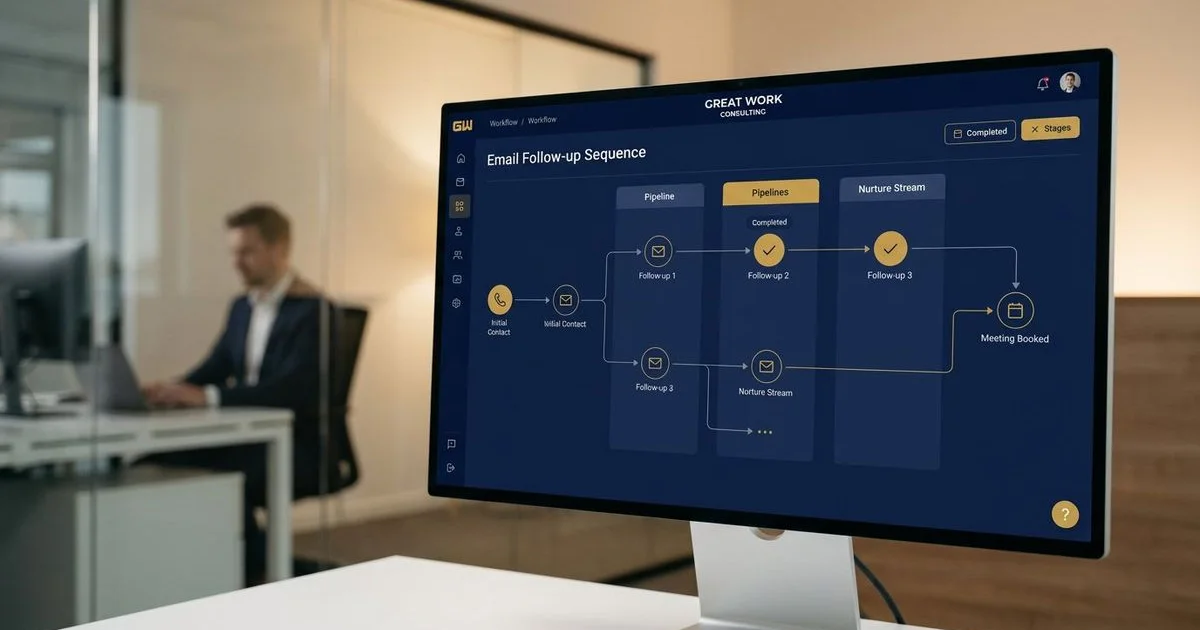
Our automated systems solve this exact problem by responding instantly and nurturing prospects until they are ready to buy. This immediate response prevents homeowners from calling three other companies while you are busy on a job site. Let us look at the data behind these missed opportunities and walk through the exact steps you can take.
In fact, learning how automated follow-up sequences can double your contractor close rate is the most profitable skill you can master this year.
Why Manual Follow-Up Fails for Contractors
We see contractors lose thousands of dollars simply because they are busy doing the actual work. You cannot operate a skid steer and simultaneously text the homeowner who submitted a form six minutes ago. Leaving a crew unsupervised to make seven phone calls is simply not an option for most business owners.
Our research indicates that speed is the single biggest factor in winning the job. Recent 2026 data from Hearth shows that 80 percent of US homeowners hire the very first contractor who answers their inquiry. By the time you return to the office to check voicemails, those prospects have likely booked an estimate with a faster competitor.
We also see manual processes fail because they lack basic consistency. On a smooth day, you might call everyone back promptly and schedule site visits. A bad day throws everything completely off schedule.
Our clients frequently tell us about materials arriving late, subcontractors missing shifts, or unhappy customers demanding immediate attention. These daily fires cause lead nurturing to drop entirely off the radar. Over a single month, this inconsistency quietly kills dozens of potential deals that you never even knew existed.
Automation does not replace your personal communication or sales skills. It simply ensures that the critical early stages of the relationship happen reliably. Here is what a basic system handles for you:
- Instantly acknowledging new web forms or missed phone calls.
- Setting clear expectations for when a project consultant will reach out.
- Delivering educational content to keep the prospect engaged.
- Sending automated reminders for upcoming site visits.
How Automated Follow-Up Sequences Can Double Your Contractor Close Rate: The Blueprint
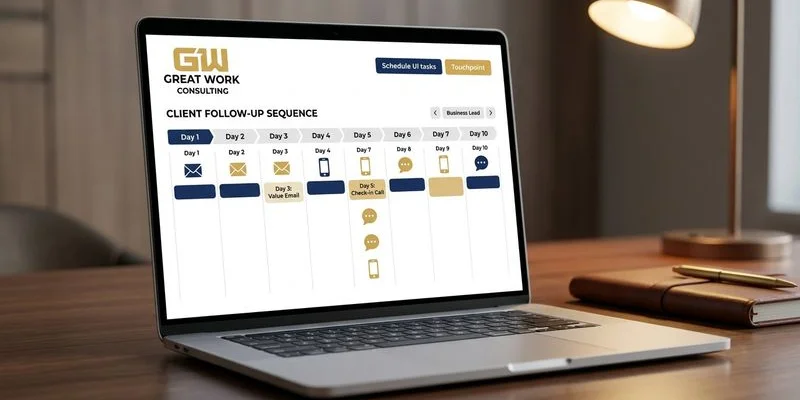
Our team uses a specific, proven sequence designed to capture and nurture outdoor living leads. This blueprint assumes a homeowner has submitted an inquiry through your website or called your office directly. The goal is to provide immediate value and keep your company top of mind until the contract is signed.
Immediate Response: 0-2 Minutes
We always trigger an automated text message the exact second a lead comes in. The message reads, “Hi [Name], thanks for reaching out to [Business Name]. We received your inquiry about [project type], and one of our project consultants will call you within the next hour. In the meantime, check out some of our recent projects: [portfolio link].” This instant response confirms receipt and sets a firm callback expectation.
Our clients find that this simple text builds immediate trust through the portfolio link. A 2025 Lead Response Management study shows that responding within five minutes makes you 21 times more likely to qualify a lead compared to waiting 30 minutes. The homeowner immediately knows you are real, responsive, and highly professional.
We follow up the text with a detailed welcome email. This email includes a company overview, service areas, and a direct link to schedule a consultation.
Hours 1-4: Personal Follow-Up Window
Our strategy shifts back to a human touch during this crucial four-hour window. This is where your sales team takes over and calls the lead directly. If the prospect does not answer, you must leave a voicemail and send a quick, personal text message.
Our data from Focus Digital’s 2025 US conversion report shows that sales call close rates for warm, responsive leads hover around 25 percent. Scheduling the site visit during this initial phone call is the absolute best way to hit that maximum conversion rate. If you cannot reach them, the automated sequence continues working in the background.
Day 2: Value-Add Follow-Up
We send an automated email on the second day focused entirely on helpful content. If they inquired about a patio, send an article titled “5 Things to Consider Before Building Your Dream Patio.” For an outdoor kitchen, deliver “The Complete Guide to Planning Your US Outdoor Kitchen.”
Our goal here is to position your business as a trusted expert rather than just another salesperson. According to SimpleTexting’s 2025 report, 84 percent of consumers have actively opted in to receive texts and emails from businesses. Providing educational resources capitalizes on this high engagement rate and gives the lead a strong reason to interact.
Day 4: Social Proof Follow-Up
Our next touchpoint uses automated SMS to share a specific customer testimonial. Include a photo of a completed project that closely matches their initial inquiry. Social proof at this stage reminds the homeowner why they reached out in the first place.
We rely on this step to emulate the experience of a personal recommendation. Referrals convert at a massive 25.6 percent rate according to 2025 industry benchmarks. Displaying real results from actual US customers in their local area creates that same powerful sense of trust.
Day 7: The Check-In
We send a highly specific text message at the one-week mark. The text says, “We have not connected yet about your outdoor living project. We are currently booking estimates for the next 2-3 weeks, so would you like to get on the schedule?” Adding a gentle sense of urgency through scheduling timelines encourages action without feeling pushy.
Our seasonal clients find this tactic especially effective during the busy spring and early summer months. The 2025 Atreyus AI “Speed Tax” calculator reveals that contractors lose up to 20 projects a month simply by letting communication stall. This check-in message prevents that stall and forces a helpful decision.
Day 14: The Long-Play Email
Our two-week follow-up shifts to a longer, more detailed case study delivered via email. You should include before-and-after photos, a breakdown of the design process, the project timeline, and a glowing customer review. End the email with a very clear call to action to schedule a consultation.
We see many leads still stuck in the decision-making phase at the 14-day mark. A well-crafted case study keeps you front of mind while your competitors have already given up. Recent 2025 data from the Electrician Marketing Agency shows that high-revenue contractors generate 11 to 15 percent of their total income simply by maintaining a structured follow-up process for older leads.
Day 21: The Direct Ask
We use a very direct, low-pressure text message at three weeks. The message reads, “I want to make sure your project is taken care of, even if it is not with us. Are you still considering this project, or has something changed?” This genuine approach is remarkably effective at reopening closed doors.
Our tracking shows that it frequently restarts conversations with homeowners who simply got busy or distracted. Project Broadcast’s 2026 data confirms that SMS messages have a massive 45 percent response rate, compared to a dismal 6 percent for email. Sending this direct ask via text maximizes your chances of getting a definitive answer.
Day 30: The Final Touchpoint
Our final automated email acknowledges that the timing might not be right for a project. The system leaves the door open by providing contact information and a brief note about planning ahead for future scheduling. After day 30, you should move the lead into a monthly newsletter sequence.
Our goal is to maintain brand awareness without annoying the prospect with aggressive sales pitches. A 2025 report from Nucleus Research highlights that CRM automation increases total sales by up to 29 percent. Keeping leads in a long-term drip campaign is exactly how you capture that impressive revenue boost.
Advanced Automation Tactics
Our approach to automation goes far beyond basic email autoresponders. You need to segment your audience and handle specific scenarios to maximize your return on investment.
Sequence Branching by Lead Type
We never send the exact same sequence to every single lead. You must build separate branches based on the project type, the specific lead source, and the stated budget range.
Google Ads leads display much higher intent and warrant faster, more direct sales language. Our social media leads are often just browsing and respond much better to educational design content. High-value US project inquiries should receive premium touches, such as personalized video messages from the owner.
Missed Appointment Recovery
We immediately trigger an automatic recovery sequence when a homeowner schedules a consultation and fails to show up. The system follows up with a rescheduling link, and then sends another message 24 hours later using an understanding, professional tone.
Data from Concept’s 2025 US appointment report shows that the average B2B and contractor no-show rate hovers around a painful 30 percent. Our implementation of immediate calendar invites and automated recovery texts makes prospects 40 percent less likely to miss their time slot. This single automation acts as a massive revenue safety net.
Post-Estimate Follow-Up
Our most profitable sequence fires right after you send a formal estimate. This automation includes a check-in on day one, a question prompt on day three, a social proof testimonial on day seven, and a scheduling urgency message on day fourteen.
This post-estimate sequence is where the majority of US contractors leave staggering amounts of money on the table. Our top-performing clients treat the submitted estimate as the beginning of the sales process, not the end.
Measuring Automation Performance
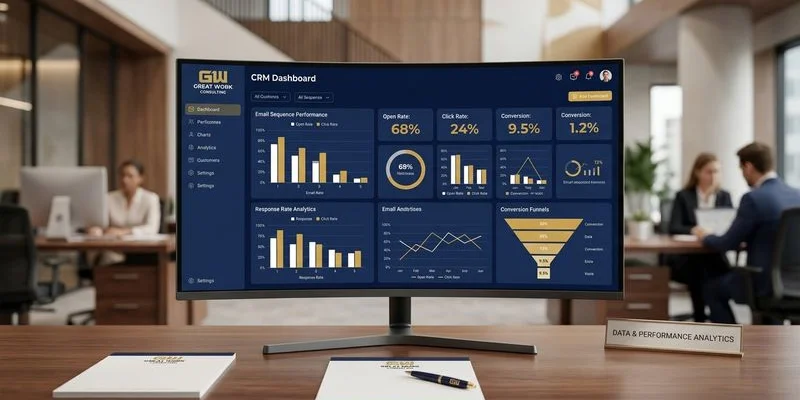
We track specific metrics every single month to optimize these communication sequences. You cannot improve a system if you refuse to measure its baseline performance.
According to SimpleTexting’s 2025 data, most businesses see an average SMS click-through rate between 21 and 35 percent. Our team uses that 21 percent mark as a baseline goal for all client campaigns.
| Performance Metric | What It Measures | 2025/2026 Target Benchmark |
|---|---|---|
| Response Rate | Percentage of automated messages that get a reply | 40-45% for SMS, 5-10% for Email |
| Appointment Booking Rate | Number of sequence leads that schedule a site visit | 15-20% of total qualified leads |
| Sequence-to-Close Rate | Percentage of entered leads that sign a contract | 15-25% depending on service price |
| Opt-Out Rate | Percentage of users unsubscribing from messages | Under 2% per campaign |
We use this concrete data to constantly refine the approach. If your day four message gets significantly more responses than day two, the earlier message requires a rewrite. A sudden spike in opt-outs after the third touchpoint means you need to ease back on the frequency. Our constant monitoring ensures that your growing text marketing budget actually generates a positive return.
The Math That Makes Automation Obvious
We want to look at a realistic scenario for a standard US contractor business. Say you generate 50 leads per month and currently close 10 percent of them, resulting in 5 secured projects. With an automated follow-up system in place, a very conservative improvement takes your close rate to 18 percent, yielding 9 total projects.
Our baseline average for an outdoor living project sits around $20,000. Those 4 additional projects represent $80,000 per month in new revenue, captured from leads you are already generating and already paying to acquire.
The CRM and automation platform required to run this system costs roughly $100 to $300 per month.
The return on investment is absolutely undeniable. Our experts can help you select the perfect software for your specific needs. For guidance on choosing the right platform, see our CRM and marketing automation consulting page.
Understanding how automated follow-up sequences can double your contractor close rate changes your entire approach to sales. Ready to build automated follow-up sequences that convert more of your existing leads into signed contracts? Book a Free Operations Audit and we will map out a custom automation strategy designed specifically for your business, your lead flow, and your sales process.