We often hear the same late-night worry from successful founders. You built a profitable operation, but figuring out how to step away feels like a completely different job. Data from a 2026 McKinsey report shows that up to six million small businesses will need to transition ownership in the next decade.
Our professional service team knows the hard truth is that unprepared companies risk liquidation instead of a lucrative exit.
When approaching succession planning for contractor business owners, the mandate is clear: start now, not later.
We are going to outline the three main exit routes and then break down a five-year timeline to maximize your valuation. Let’s examine the options.
The Three Exit Paths for Contractor Businesses
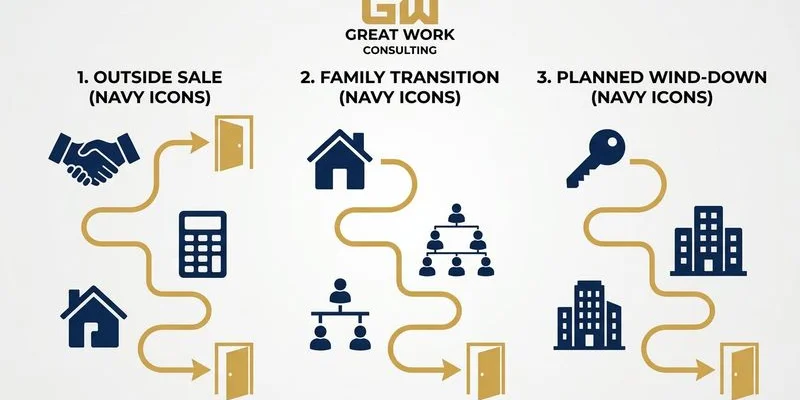
You need to decide where your company is headed before drafting a transition document. Most owners exit through one of three distinct routes.
Path 1: Sell to an Outside Buyer
This is the most common exit path for contractor businesses that have built value beyond the owner. An outside buyer, often a private equity group or a strategic acquirer, purchases the business for a multiple of earnings.
We see outside buyers remain ruthless about valuation. They pay top dollar for systematized operations with low owner dependency, and they discount businesses that rely on you personally. For a detailed guide on what buyers evaluate, read our post on how to value a contractor business.
Current 2025 data from Clearly Acquired shows the median EBITDA multiple for private construction transactions is 3.8x. However, the exact multiple depends heavily on your specific trade.
| Trade Specialization | Average EBITDA Multiple |
|---|---|
| HVAC & Plumbing | 5.1x |
| Electrical Contractors | 5.0x |
| General Commercial Construction | 3.2x |
Path 2: Transition to Family or Key Employees
Passing the business to a family member or a trusted employee is emotionally appealing. Your legacy continues, the people you care about benefit, and the company name stays on the trucks.
The execution phase carries significant risk. A 2025 DealFlowAgent analysis reveals that 70% of family businesses fail to survive the transition to the second generation. Not every child wants the business, and employee buyouts require complex financing.
We highly recommend reviewing the latest federal lending guidelines if your employees plan to borrow money for the buyout.
Employee buyouts face specific financial hurdles:
- Reduced Loan Limits: The Small Business Administration (SBA) capped 7(a) Small Loans at $350,000 in 2025.
- Stricter Underwriting: Larger acquisition loans now require standard, rigorous 7(a) processing.
- Seller Financing: Owners often must carry a note for 10% to 20% of the total purchase price.
Both paths require the successor to take on more responsibility over a multi-year period. You cannot hand someone the keys on a Friday and expect them to run the company on Monday.
Path 3: Wind Down and Close
Some contractor businesses do not have a natural successor and cannot attract an outside buyer. The most honest route may be a planned wind-down.
We know this sounds like a failure, but a planned closure preserves your wealth. The Exit Planning Institute reports that only 30% of small businesses successfully sell. If your operation generates income primarily through your personal effort, a wind-down might be your most realistic option.
An unplanned closure triggered by health issues destroys value and creates immediate legal complications.
Done properly, you complete existing contracts and sell equipment at fair market value. Liquidating assets through recognized industrial auctioneers like Ritchie Bros. helps recover maximum value for heavy machinery.
The Five-Year Succession Timeline
Preparation follows a strict schedule regardless of your chosen route. Starting half a decade early gives you leverage.
Years 5-4: Foundation Building
Assess your current position by getting a professional valuation. You need to understand what your business is worth today and identify the gaps for your chosen exit path.
We advise owners to address their personal tax exposure immediately. The impending 2026 sunset of the Tax Cuts and Jobs Act means estate tax exemptions will drop significantly, making early valuation critical for high-net-worth families.
Professional financial consulting services help contractors establish this necessary infrastructure.
Key foundation tasks include:
- Tax Planning: Prepare for the 2026 estate tax exemption sunset.
- Financial Cleanup: Separate all personal expenses from company books.
- System Upgrades: Adopt construction-specific tools like Procore to document project profitability.
Years 3-2: Team Development
Identify and develop your successor early. A new leader needs two to three years of progressive responsibility before they can run operations independently.
We see buyers actively discount valuations if the founder holds the primary relationships with top general contractors. You must systematically transfer these key relationships to your management layer.
Build your team by promoting people into project management and sales. For a detailed framework on this process, read our guide on reducing owner dependency in your contractor business.
According to a 2026 Deloitte Private survey, 78% of family businesses expect a CEO transition within a decade, but only 23% are actively preparing the next leader.
Years 2-1: Transition Execution
Formalize the deal structure by engaging a business broker or M&A advisor. Firms specializing in construction, such as BMI Mergers & Acquisitions, understand the nuances of project backlogs and equipment valuation.
Address legal implications early. Work with an attorney to draft the necessary transition documents.
Commonly required transition documents include:
- Buy-Sell Agreements: Outlining terms for internal transfers.
- Asset vs. Stock Structures: Determining the tax liability for both parties.
- Non-Compete Clauses: Protecting the buyer from future competition.
We recommend taking an extended, one-month vacation to test the transition. Observe how the business performs without you and fix the gaps that surface.
Year 1: Handoff
Execute the final transition by transferring ownership and introducing the new leader to key vendors. Most successful deals include a formal consulting period.
Standard agreements usually require the departing owner to remain available for guidance for 6 to 12 months.
We find that retaining key employees during this phase is much easier if you implement formal stay bonuses tied to a one-year retention metric. Clear communication about what is changing preserves valuable relationships.
Common Mistakes in Succession Planning for Contractor Business Owners
Starting Too Late
The most costly error is compressing your preparation timeline. Trying to prepare a company for sale in six months produces a fraction of the value that a multi-year effort yields.
We watch owners rush the market and suffer massive financial penalties.
Data from BizBuySell shows that even well-prepared businesses take an average of 6 to 8 months to close after listing.
You cannot implement systems, develop a team, and clean up financials overnight. Maximize your value by giving the process the time it requires.
Assuming Your Kids Want the Business
Many contractor owners assume their children will automatically take over the company. Some will, but many have different career aspirations. Have honest conversations early.
Even if your children express interest, they might lack the temperament to run a contracting firm successfully.
A 2025 study from Cornell SC Johnson found that nearly half of family business failures are precipitated by the founder’s unexpected death or forced retirement without a prepared heir. You need enough lead time to pursue an alternative path if your kids decline the opportunity.
Ignoring the Financial Structure
Selling a business is not like selling a house. The tax implications of how you structure the deal can dramatically affect your net proceeds.
We urge sellers to evaluate their corporate structure before entering negotiations. Selling a C-Corporation without proactive planning can trigger double taxation at both the corporate level (21%) and the personal shareholder level.
Engage a tax advisor early to discuss asset sales, installment payments, and earn-out provisions.
Not Building a Business That Can Be Sold
Many owners spend their careers optimizing for annual income rather than long-term asset value. They pay themselves generously and keep the operation lean on middle management.
This approach maximizes current income but destroys the company’s valuation.
Professional buyers will request a rigorous Quality of Earnings (QofE) report to scrutinize your books. They specifically look for:
- Owner-dependent revenue streams.
- Personal expenses run through the business.
- Customer concentration risks.
The shift from income extraction to value creation is the single most important strategic decision you will ever make.

The Emotional Side of Succession
Let us be direct about a topic that financial books often skip. Leaving a business you built creates an overwhelming emotional vacuum.
Your identity, daily routine, and social connections are tied directly to the company.
A 2026 Deloitte Private survey noted that 62% of executives delay planning because they claim it is not a critical priority, which often masks a deep fear of losing control.
We advise planning for what comes next before you sign the final papers. Have interests and a clear purpose outside of the industry.
Owners who transition successfully often join peer groups like Vistage to maintain intellectual stimulation. You must be moving ahead to a new goal, not just running away from work.
Why Succession Planning for Contractor Business Owners Must Start Now, Not Later
Every year you delay planning costs you actual money. Successors take time to develop, and market conditions fluctuate unpredictably.
Starting now does not mean you have to exit tomorrow. It means giving yourself options.
We encourage you to prepare while your company is strong. The market heavily favors sellers who present clean financials and systematized operations.
Prepared contractors gain distinct advantages:
- They command premium valuations.
- They dictate the timeline of the transition.
- They preserve their family legacy.
You can find comprehensive guidance by visiting the exit strategy and business valuation consulting page.
Ready to start planning your contractor business succession?
Book a Free Operations Audit to get a clear assessment of where your business stands today.
We will identify the exit path that aligns with your goals and build a timeline to maximize your options.
Succession planning for contractor business owners requires a proactive approach.
Start now, not later, to secure your financial future.