We have watched countless US landscape contractors hit a financial wall the moment November arrives. The phone stops ringing, and by January, panic over covering truck payments sets in.
Overcoming the Seasonal Cash Flow Slump in the Green Industry starts with recognizing it as a predictable cycle.
Our professional service team sees this exact timing problem drain bank accounts every winter.
A 2025 Mordor Intelligence report projects the US landscaping market will hit $196.16 billion by 2026. Plenty of revenue exists during peak months, but poor management wastes that capital.
We are going to break down the main reasons this happens and walk through practical workarounds. Let us look at the data, see what it tells us, and build a strategy. This approach will help you keep the lights on and retain top talent year-round.
The Real Problem: Revenue Timing vs. Expense Timing
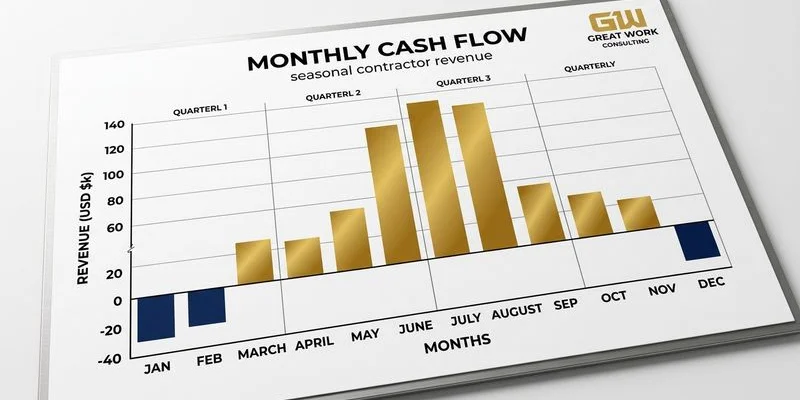
We know that cash flow problems in seasonal businesses fundamentally stem from timing. Revenue concentrates heavily in a six to eight month window, but expenses run twelve months straight. During peak season, money pours in and everything feels fine.
Our data shows that a significant portion of peak revenue must cover the four to six months of low income. The math remains straightforward but highly uncomfortable for most business owners. A 2026 analysis from Financial Models Lab shows a typical mid-size US landscaping company carries a fixed cost floor of $40,108 per month just for basic payroll, software, and facility rent.
We find that four slow months require a massive reserve just to keep obligations covered. Most contractors lack this reserve because they spend peak cash as fast as it arrives. New equipment, bigger trucks, and owner distributions get justified by healthy summer numbers.
| Financial Phase | Revenue Status | Expense Reality | Action Required |
|---|---|---|---|
| Spring/Summer Peak | High | High (Variable) | Save heavily |
| Late Fall Transition | Moderate | Moderate | Reduce variable costs |
| Winter Slump | Low to None | Fixed Only | Draw from reserves |
We frequently see winter arrive and expose these dangerous financial habits. The sudden drop in revenue catches poorly prepared companies completely off guard. Surviving this slump requires a fundamental shift in how you view your bank balance.
Building Your Cash Reserve: The Foundation of Seasonal Survival
Our consulting experience proves that building a cash reserve is absolutely not optional. The most important financial discipline involves saving enough to cover off-season expenses. This financial foundation prevents every slow season from becoming an existential crisis.
Calculate Your Off-Season Cash Need
We always recommend categorizing expenses clearly before doing any math. Start by listing every single expense that continues during your slow months. A common mistake involves forgetting annual subscriptions or minor loan payments.
- Fixed overhead: Rent, insurance, utilities, phone, internet, and software subscriptions.
- Vehicle payments: Truck loans and heavy equipment financing.
- Minimum payroll: Essential year-round employees required for operations.
- Owner’s draw: Necessary personal living expenses for the winter.
- Marketing: Ongoing SEO, website hosting, and digital presence costs.
We strongly advise adding a 20 percent buffer to your final calculation. Total these monthly expenses and multiply them by the number of slow months in your regional market. If your fixed monthly expenses hit $18,000 across four slow months, your absolute minimum target becomes $72,000.
Fund the Reserve During Peak Season
We typically see successful seasonal contractors transfer between 15 and 25 percent of gross revenue into savings. Set up a completely separate business savings account at a different bank than your operating funds. Transfer a fixed percentage of every single payment received during peak season into that specific reserve account.
We consider this habit the single most impactful financial move a business owner can make. This transfer must happen automatically before you pay yourself a bonus or upgrade equipment. The reserve gets funded before any discretionary spending occurs.
Payment Terms That Accelerate Cash Collection
We frequently catch contractors accidentally creating cash shortages by using payment terms that drastically delay collection. How and when you collect money directly dictates your daily cash flow position. A 2025 Association for Financial Professionals report notes that a healthy Days Sales Outstanding metric should stay under 45 days.
Collect Deposits Upfront
We consider a 50 percent deposit standard and reasonable for outdoor living projects with significant material costs. Require a deposit of 30 to 50 percent before officially scheduling any project. This initial deposit safely covers material purchases and provides positive cash flow before labor costs begin.
Structure Progress Payments
Our team uses a specific percentage breakdown to keep cash moving smoothly on long jobs. Projects lasting more than two weeks require structured progress payments at defined, measurable milestones. A typical $40,000 hardscape project needs clear collection points to protect the contractor.
- 50 percent deposit ($20,000) collected right at contract signing.
- 25 percent progress payment ($10,000) collected at base completion.
- 25 percent final payment ($10,000) collected at project completion and walkthrough.
We warn clients that waiting 30 days for a final check drains operating funds dangerously fast. This rigid structure ensures the business is never more than a few days of work ahead of collection. A competitor who bills the entire $40,000 at completion finances the whole project out of their own pocket.
Invoice Immediately and Follow Up Relentlessly
Our industry research highlights a 2025 Aspire Software report showing 67 percent of top landscaping businesses send invoices the exact same day. Send the bill the moment a milestone is reached or a project finishes. Every single day you delay invoicing acts as a day of free financing provided to the customer.
We recommend using automated platforms like InvoiceFly to issue reminders without manual effort. Follow up on unpaid invoices aggressively at 7 days, 14 days, and 21 days. Accounts receivable aging beyond 30 days drain cash flow and signal a broken collection system.
Off-Season Revenue Strategies
We help contractors identify lucrative winter services that utilize their existing equipment. The best way to improve off-season cash flow is simply to generate new winter revenue. While installing patios in January is impossible in most US markets, overlooked opportunities exist.
Winter Project Types
We strongly suggest leveraging specific cold-weather projects to keep crews busy. A 2026 Trim Automation industry study shows residential snow removal packages at $150 per month lock in substantial cash. Selling 30 of these packages secures $18,000 in reliable winter revenue before the first snowflake falls.
- Landscape lighting: Installation and maintenance work continues easily through winter in many climates.
- Holiday lighting: A high-margin seasonal add-on generates $200 to $800 per residential property.
- Snow removal: Plowing leverages existing trucks and established commercial client relationships.
- Indoor hardscape: Basement patios, sunroom flooring, and custom interior stone work sell well.
- Design consultations: Paid design services for spring projects generate immediate winter income.
Pre-Selling Spring Work
We have found that pre-season quotes sent in January yield a 30 to 40 percent acceptance rate. Offer early-booking incentives for homeowners who commit to spring projects during the cold months. A 5 percent discount for contracts signed before March 1 brings in crucial deposits during December and January.
We rely on these early commitments to stabilize operational planning for the upcoming year. This strategy fills your spring schedule while dramatically improving your off-season cash position. Planning material orders and forecasting revenue becomes much easier with confirmed commitments.

Managing Expenses Through the Slow Season
We train operators to ruthlessly evaluate every outgoing dollar between November and March. Building revenue and reserves stands as the primary strategy, but managing expenses holds equal importance. Contractors must actively shrink their financial footprint when production volume drops.
Reduce Variable Costs
We caution that running three trucks daily for one working crew means your costs are completely out of alignment. Variable costs naturally decrease during the off-season as production slows down. Things like fuel, material purchases, and temporary labor should drop off a cliff.
We constantly check the profit and loss statement to verify these reductions actually happen. Material costs alone often consume 40 percent of revenue, so minimizing inventory is vital. Managers must ensure field activity matches the reduced financial outlay.
Negotiate Payment Timing
We successfully negotiate Net 60 terms with US suppliers to align cash outflows with collections. Talk to vendors, insurers, and lenders about restructuring payment timing. Many insurance companies provide payment plans that spread annual premiums across twelve equal months.
We remind owners that these specific negotiations do not reduce total costs, but they vastly improve cash timing. Equipment lenders frequently allow seasonal payment structures featuring lower payments during winter months. Simple communication with creditors keeps your bank account from draining too fast.
Retain Key Employees Strategically
We see that retaining a skilled installer through winter costs far less than training a rookie in April. Your best crew members represent your most valuable operational asset. According to 2026 data from SHRM, the average cost to replace an employee sits around $4,700 just for recruiting.
We remind clients that total replacement costs, including lost productivity, can reach 50 percent of the worker’s annual salary. Losing top talent and training replacements every single spring is wildly expensive and disruptive. Consider which specific employees remain critical and budget to keep them on reduced hours.
Create a 12-Month Cash Flow Forecast
We always utilize platforms like QuickBooks Online to build essential forward-looking models. The most powerful financial tool for any seasonal contractor is a rolling 12-month cash flow forecast. This month-by-month projection shows exactly when money will be tight and how large the gap will be.
Our financial consulting team builds these forecasting systems with contractor clients so that cash flow surprises disappear entirely. Update this specific forecast monthly using actual numbers as they arrive from the bank. Spotting a shortfall three months out gives you time to accelerate collections or defer spending.
We stress that reacting to a crisis next week leaves you with incredibly expensive options. The goal is to see every financial challenge coming months before it arrives. Clear visibility changes the way a business operates.
Conclusion: Overcoming the Seasonal Cash Flow Slump in the Green Industry
We help companies implement strong reserves, strict payment terms, and clear forecasts to protect their profits. Overcoming the Seasonal Cash Flow Slump in the Green Industry requires treating off-season challenges as predictable events rather than shocks. Thriving businesses build permanent financial systems that account for seasonality as a core feature of their model.
We are ready to map out your seasonal cash flow and build a plan that keeps your business healthy. Securing year-round stability takes discipline, but the peace of mind is worth the effort. Ready to build a financial system that eliminates the off-season panic? Book a Free Operations Audit and fix your bottom line.